
The squat exercise is an incredible movement for developing powerful and explosive leg muscles. Squat performance is also a useful indicator of leg strength, mobility and fall risk in older age.

The Muscles
The squat exercise strengthens the quadriceps muscles on the front of the thigh, the glutes (butt muscles) and the adductor magnus muscle, an underappreciated hip extensor on the inside of the thigh.
Most people think squats beef up the hamstrings, but they don’t – the hamstrings don’t work very hard during a squat.
This is because the hamstrings are biarticular muscles, meaning they cross two joints – as you can see below, the 3 hamstring muscles cross the hip and the knee joints.
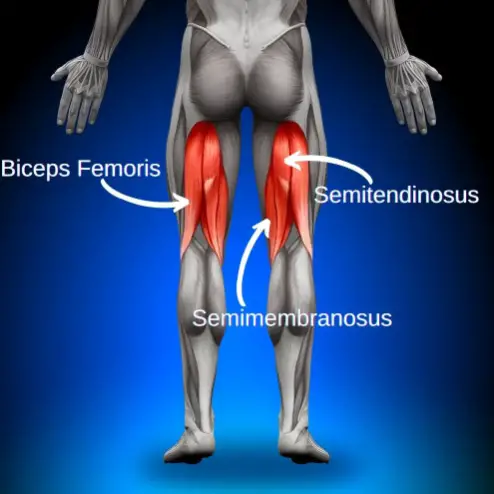
The hamstrings bend the knee and extend the hip. During a squat, only one of these motions happens at a time – the knees bend while the hips flex (descent) or the knees extend and the hips extend (ascent).
So the hamstrings remain the same length during a squat. Subsequently, they aren’t a primary squat muscle.
Knees Over Toes
The biggest squat myth is that it’s dangerous for the knees to travel forward over the toes.
While the “knees over toes” position puts a lot of stress on the front of the knee (quadriceps muscles, quad tendon, patellofemoral joint, and patellar tendon), stress is good.
Because stress makes our bodies stronger.
That’s why activities like running, sports and weightlifting build physical durability and resilience.
The human body can adapt to almost anything when we start slowly, allow time for recovery, and use an appropriate amount of resistance or training load.
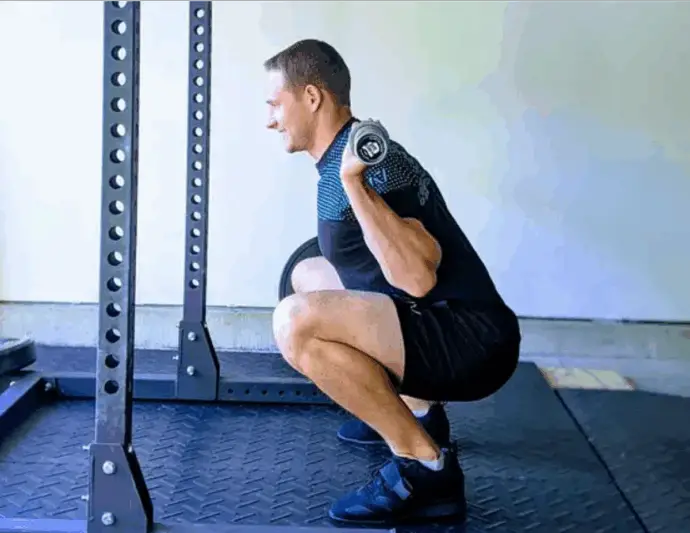
A decade of heavy barbell squats have made my knees stronger and more resilient – I squat over 550 lbs with “knees over toes” and no knee pain.
Squatting in Daily Life
Avoiding the squat movement in daily life is almost impossible. Just try sitting on a chair, getting into a car, or lowering yourself onto the toilet.
Squatting is a fundamental movement that allows us to perform everyday activities more easily.
At The Doctor’s Office
Physicians and physical therapists use variations of the squat exercise to assess fall risk, leg strength and mobility.
Specifically, clinicians employ the 5 Times Sit-to-Stand Test, which measures the time it takes to rise from a chair five times consecutively.
We also use the 30-Second Sit-to-Stand Test, which assesses how many sit-to-stands a client can complete in 30 seconds.
Clinicians compare these objective measures to age-matched norms to evaluate leg strength and fall risk.
In The Gym
The barbell back squat is the ultimate exercise for building leg strength. The barbell allows athletes to lift heavy loads, causing massive strength and muscle mass gains.
So if your goal is to build bulletproof knees and powerful legs, the barbell back squat is a superb exercise.
However, some individuals struggle to execute a barbell back squat with proper technique, because it requires skill and body control to perform it correctly.
If you’re struggling with the barbell squat, master these easier alternatives first:
1) Sit-to-Stand: Start in a seated position on a chair, then stand up while keeping your arms reaching out in front of you. Slowly lower yourself back down into the starting position.
2) Air Squat: With your arms extended forward, squat down until your thighs are parallel to the floor, then stand back up. It’s essentially a sit-to-stand without a chair.
Pro tip: Keep your weight through the middle of your foot as you squat. “Weight on your heels” is a bad squat cue because it reduces forward knee travel and ultimately leads to technique break-down.
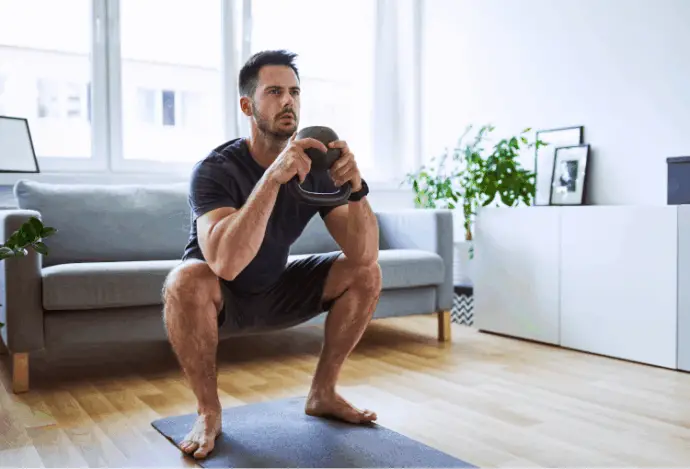
3) Goblet Squat: Once you’re comfortable with the air squat, it’s time to add weight. Hold a dumbbell or kettlebell in front of your chest and perform the air squat movement (pictured below).
Programming The Squat
To build your squatting capabilities (and strong, healthy knees), include a squat movement in your exercise routine 2-4 times per week.
If your goal is to build lift-more-than-your-friends strength, aim for 3 to 8 repetitions per set.
Looking to add muscle mass? Aim for 6 to 12 reps per set.
Adding the squat exercise to your training will help you build resilient knees, gain leg strength, and live longer with a high quality of life.
As a bonus, you can use squats to join the elite group of individuals who meet physical activity guidelines
To learn more scientific strategies to get healthier, join the free Facts & Physio Newsletter. Plus, get The Recovery Checklist when you sign up.