
Forging Herculean strength isn’t complicated. But it isn’t easy. Here are the 5 key steps to build muscle strength fast.
1) Select Effective Exercises
Choose exercises that mimic your intended goal. Exercise adaptations are training-specific, according to the specificity principle.
For example, push-ups are dissimilar to running. So cranking out hundreds of push-ups won’t make you an elite distance runner. Running long distances will.
So if you’re striving to become a stronger runner, practice running and running-specific strength exercises.
Likewise, the best way to build muscle strength to deadlift more (weight) is to deadlift more (often).

To build strong bones, joints and muscles, choose compound exercises that recruit multiple large muscle groups.
Isolating each muscle group takes too long – unless you enjoy spending hours on toe crunches and forearm curls.
The 3 best free-weight exercises for building full body strength are the barbell squat, bench press and deadlift. Add overhead press and barbell row for extra credit.
Prefer to use weight machines? Opt for the leg press, chest press and seated row for efficient, full-body strengthening.
2) Build Incrementally
Progressive overload – incrementally increasing intensity over time – is the main way to build muscle strength over time.
You can’t get stronger if you do the exact same workout week after week, year after year.
It’s the same with aerobic exercise, if you run a 10-minute mile once a week for 5 years straight, you’re not going to become a faster runner.
The obvious solution – add weight to the bar, do another repetition or run a little faster over time. Naturally, it helps to track your workouts.
My worst exercise mistake – I didn’t track my training for years.
I went to the gym and tried hard. But my workouts were unstructured and random. And, no surprise, my progress was slow.
3) Strive for Consistency
In any pursuit, mastery requires consistency, not perfection. And not heroic effort every once-in-a-while.
Build the exercise habit first, then add sets, repetitions and intensity as you gain momentum. This “brick by brick” approach is safer and more sustainable than diving 110% into the first workouts of a new program.
It’s a classic tortoise-and-the-hare scenario. Choose to be the plodding, consistent tortoise.
4) No Shortcuts
There’s no way around it. It’s hard to build muscle strength.
The process builds character. Patience. Grit. And mental toughness.
How do I train harder?
Several research-backed strategies can take your training to the next level.
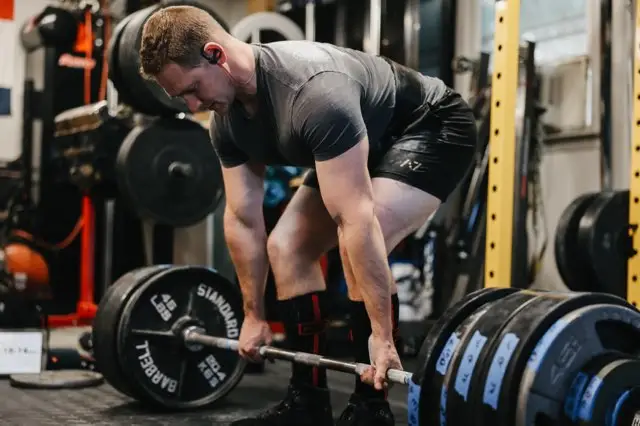
For example, energizing music and lifting with a stronger workout buddy (called the Kohler effect) are proven techniques to exercise harder.
For more insights on grinding through hard sessions, check out 7 Proven Workout Motivation Strategies (to Beat Fatigue).
5) Gain Weight
Bigger muscles move bigger weights. The fastest way to add muscle mass is resistance training + caloric surplus. Losing fat and gaining muscle at the same time is somewhere between moderately difficult and utterly impossible. And it’s rarely the optimal choice.
Bonus Tips
Finally, consider these two tips to accelerate your strength gains.
Supplement Right
The right supplements boost performance by 5-10%. There are over 50,000 supplements on the market, but few with stacks of scientific literature behind them. Here they are: The 3 Best Fitness Supplements
Hire a Coach
A skilled coach shortens your route to success. Facts & Physio offers 3 levels of customized fitness coaching to a select handful of clients. So if you want next-level results this year, learn more here.
Pick Things Up and Put Them Down
On a personal note, I hit powerlifting meet personal bests on two of the “Big 3” lifts this year – a 584 lb Squat and a 688 lb Deadlift at ~218 lbs bodyweight. And my 1,631 lb total was enough to qualify for USA Powerlifting Raw Nationals – one of my long term goals!
For more practical, science-backed insights for health and wellness, join the free Facts & Physio Newsletter. Plus, get The Recovery Checklist when you sign up.