
Ever asked the question, “How strong are my bones?“
If you’re under age 50, you probably haven’t.
But in our later years, falling and breaking a hip becomes a major concern – and rightly so.
This article explores bone health and how you can build strong bones to prevent fragility later in life.
Why Are Bones Important?
Some bone functions are obvious, like providing structure for the body and allowing movement.
Others aren’t so apparent – protecting organs, storing minerals and producing red blood cells.
As you may recall from biology class, red blood cells carry oxygen to your cells. Oxygen does semi-important things like produce energy and keep you alive.
Wolff’s Law
Bones seem like inert tissue…Like an unchanging rock.
But unlike rocks, bones are alive. They adapt, regenerate, heal and change.
Wolff’s Law is the scientific principle that bones adapt to stress. We can build strong bones when we put weight or load through them.
The converse is also true – bones that aren’t loaded get weaker.
Wolff’s Law explains why astronauts lose bone mass rapidly in outer space, a low-gravity, low-load environment.

Osteopenia and Osteoporosis
These conditions are characterized by low bone mass. Osteopenia is less severe.
For the statistics nerds like myself, osteopenia is diagnosed when bone mass is 1 standard deviation below normal.
Osteoporosis is diagnosed at -2.5 standard deviations from normal.
Bone mass correlates well with bone strength. So doctors measure bone mass via dual x-ray absorptiometry (DEXA) to approximate bone strength and diagnose these conditions.
As you’d expect, osteoporosis elevates fracture risk – osteoporotic spinal fractures and hip fractures are particularly problematic.
Risk factors for osteoporosis include:
- Age >70
- Female
- Smoking
- Genetics
- Sedentary lifestyle
- Weight loss
On the weight loss front, not all weight loss is good weight loss. Losing bone and muscle mass is no bueno.
Semaglutide, the diabetes drug that’s been popularized for weight loss, is shown to cause massive losses in lean body mass (bone and muscle) along with substantial fat loss.
How to Build Strong Bones
Here are 3 keys to dense, strong bones:
1. Stay Active
Weight-bearing physical activity, like walking, running or the elliptical, is the bare minimum stimulus to keep your bones strong.
Non-weightbearing exercise (biking, swimming, chair yoga) has its place, but it doesn’t load your bones enough to keep them dense and robust.
2. Lift Weights
Resistance training is a powerful way to build strong bones and muscles. Researchers found the most bone-building benefit from progressive resistance training at relatively high loads – 80 to 85% 1-rep max.
For best results, choose exercises that target large muscle groups and do them 2 days a week.
Though bodyweight movements like squats and push-ups are better than nothing, add external resistance via machines or free weights for maximum bone strength.
3. Eat Healthy
Last but not least, poor nutrition weakens bones. Heavy alcohol use and excess junk food intake impair bone health.
A nutrient-rich diet including dairy, fruits, veggies and whole grains is linked to strong bones.
Furthermore, calcium, vitamin D, vitamin K play key roles in bone health. Your physician may advise you to supplement these micronutrients if you have a deficiency.

3 Moves for Stronger Bones
Try these 3 exercises for efficient bone strengthening:
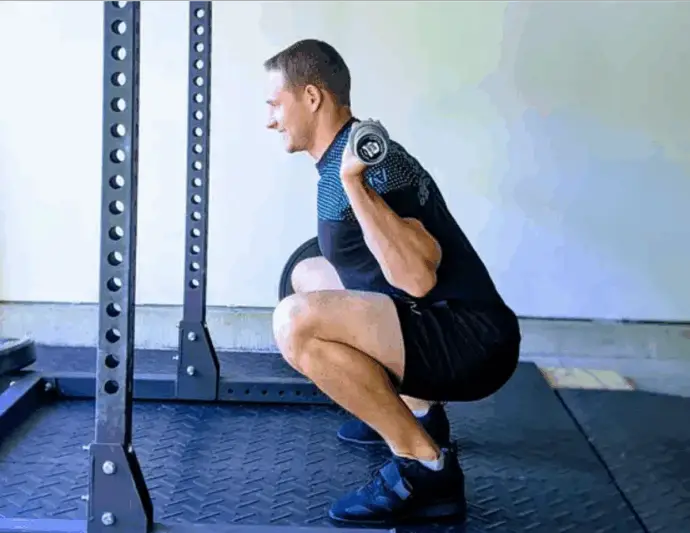
1. Squat
Grab a barbell, dumbbell, kettlebell, or small child to add external load. Squat down (to a chair if you need to), then stand back up.
The squat strengthens your quads and glutes and keeps your leg and spine bones strong.
2. Push
Do an overhead press, bench press, chest press machine or push-up to strengthen your anterior deltoids, triceps, pectorals and upper body bony architecture.
Achy shoulders? Learn how to bench press without shoulder pain.
3. Pull
The “pull” exercise strengthens the antagonist muscles opposite those targeted by the “push” exercise – your biceps, posterior deltoids, rhomboids and trapezius.
Your exercise options include a deadlift, barbell row, lat pulldown, pull-up, cable row and lawnmower row.
Can you guess which one is the best exercise for low back pain?

Learn More
For more evidence-based health insights, join the free Facts & Physio Newsletter. Plus, get The Recovery Checklist when you sign up.