
What muscle comes to mind when you hear “core strength”?
For many, a strong, visible rectus abdominis (six-pack) muscle is synonymous with a strong core.
And while the rectus abdominis is the most aesthetically apparent core muscle, forging a stable and powerful core requires more than sit-ups and crunches.
In this article: The core muscles and movements. And is core strength the ultimate back pain fix?
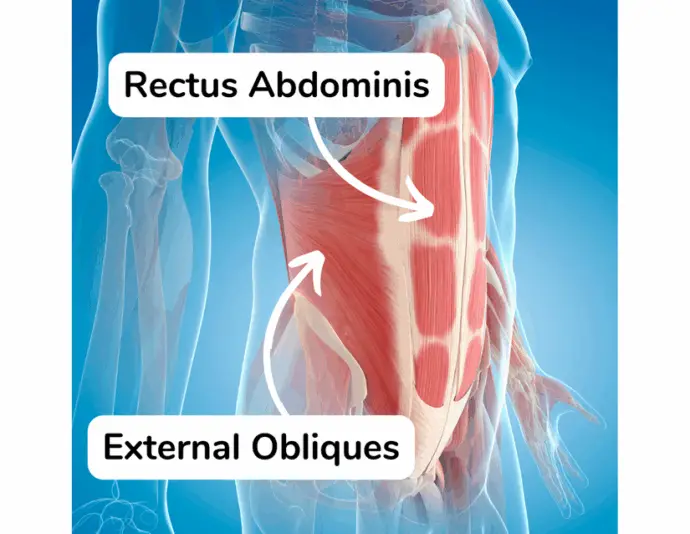
The Muscles
The core is a complex conglomerate of muscles, each with its own role in core strength.
Underneath the rectus abdominis (six-pack) sit the external and internal obliques. Another layer down you find the transversus abdominis, a stabilizing muscle that acts as the body’s built-in corset.
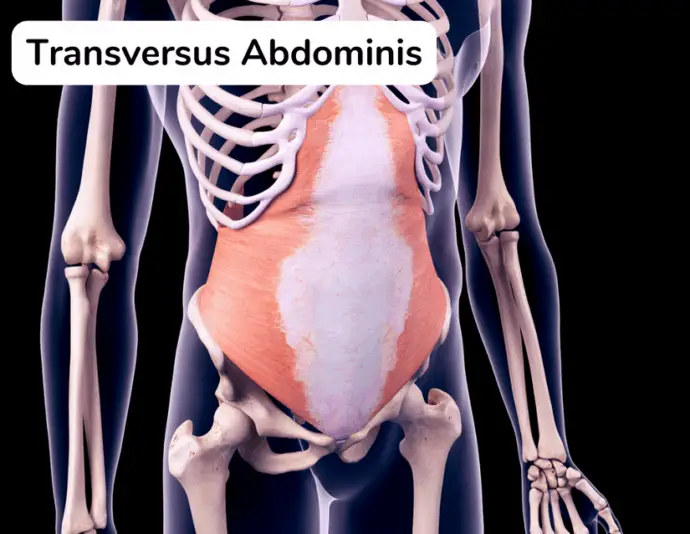
These 4 muscles (RA, EO, IO, TA) form the front and sides of the core.
Deep, posterior core muscles attach to and stabilize the lumbar spine (lower back). These muscles include the psoas major and quadratus lumborum.
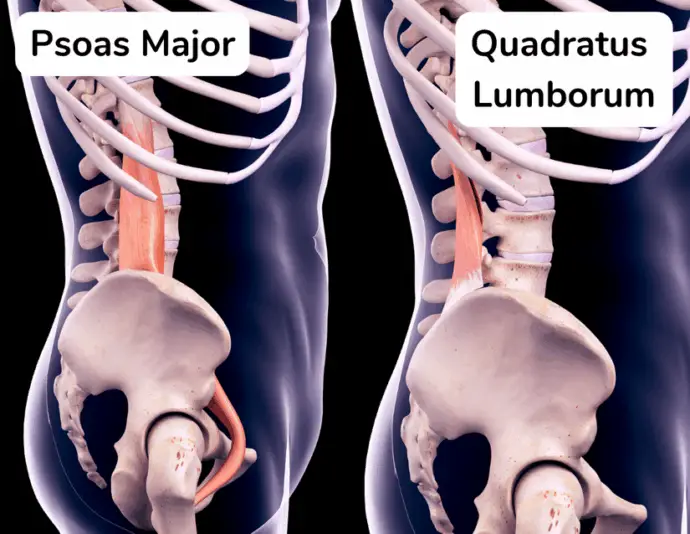
In addition, the multifidi and erector spinae muscles travel vertically along the spine.
Finally, the diaphragm sits atop the abdominal cavity and the pelvic floor muscles form the base.
The Movements
Core muscles handle a lot more than crunches.
The front 4 – the rectus abdominis, external & internal obliques, and traversus abdominis – flex the spine forward (like a crunch). They also side-bend and rotate the trunk.
And the front 4 also resist spinal extension. This prevents your torso from flopping backwards like an inflatable tube man in a stiff breeze.
The multifidi muscles control fine movement at the spine and resist spinal rotation.
The erector spinae (ES) muscles work antagonistically with the rectus abdominus. The ES muscles extend the spine, so you can pick up your child or deadlift a heavy barbell at the gym.
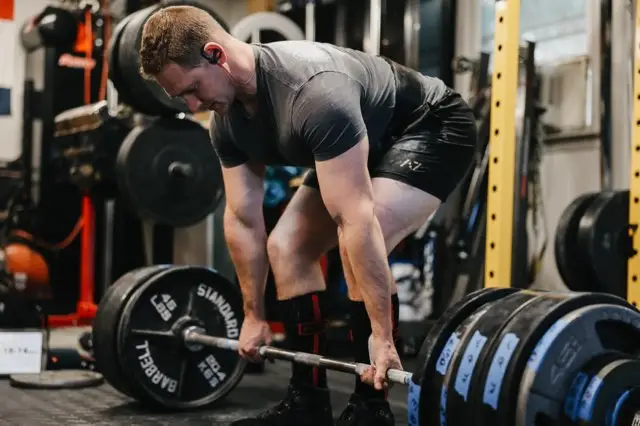
Last but not least, the core’s floor and ceiling:
The diaphragm keeps you alive via respiration (breathing). It’s also responsible for hiccups. And the pelvic floor muscles are crucial for bowel, bladder and reproductive function.
The Back Pain Fix?
Core strengthening is a popular approach for managing low back pain.
So does it work?
Well, sort of.
Core stability exercises benefit a portion of individuals with low back pain. But core activation drills are not the one-size-fix-all solution that social media might lead you to believe.
So who benefits from core stability for back pain?
Individuals who are flexible and have moderate symptoms fare best with a “core stabilization” approach.
Folks who are hypermobile benefit from strengthening exercises to control excess movement and stabilize their spines (and other joints, too).
Core strength exercises can be too aggressive for severe, acute low back pain, and too easy for athletic individuals with mild symptoms.
To learn about several interesting shortcomings of core stability exercises for low back pain, check out this research article:
The Exercises
Despite what you’ve heard, there’s no “Big 3” or “Secret 6” list of core exercises that is ideal for everyone.
Because individuals’ strengths, training experience, injury history and goals vary so much.
Nevertheless, consider these types of moves in your core workout.
- Spinal flexion (e.g sit-ups)
- Spinal extension (e.g. deadlifts)
- Spinal rotation (e.g. wood chops)
- Spinal side-bending (e.g. side plank hip raise)
And for enhanced core stability, use isometric core exercises that resist these 4 movements. For example, a front plank resists spinal extension.
Further Reading
Is there one back pain exercise to rule them all?
Stack up all the back pain studies, and this controversial movement comes out at (or near) the top.
Learn how this common and contentious exercise relieves back pain in this article.
And for more evidence-based training and rehab insights, join the free Facts & Physio Newsletter. Plus, get The Recovery Checklist when you sign up.